Quick summary
- On 15 December at this latitude there is no sunrise at all. There is still twilight, but no sun above the horizon.
- Mid-January brings the sun back for about two and a half hours a day, and the gain after that is fast.
- The season runs from late August to early April, and it is the darkness that makes it possible rather than the temperature.
- The long blue hour either side of noon in midwinter is what most winter photographs of Lapland actually show.
What 67.8 degrees north does to a day
Levi sits at 67.84 degrees north, which is about a hundred and fifty kilometres above the Arctic Circle. That single number governs everything on this page. Above the Arctic Circle there is at least one day a year when the sun does not rise and at least one when it does not set, and the further north you go the longer both periods last.
At this latitude the sun stays below the horizon for roughly three weeks around the winter solstice and stays above it for roughly a month around midsummer. On 15 December, the middle of the darkest month, the calculated daylight at Levi is zero hours. On 15 June it is twenty-four.
Between those two extremes the change is not gradual. It accelerates. The daily gain in late January and February is several minutes a day, which is fast enough to notice across a week-long stay.
The polar night, and what it actually looks like
The Finnish word is kaamos, and the thing it describes is widely misunderstood. Polar night does not mean darkness for twenty-four hours. It means the sun does not clear the horizon, which is a different and much prettier proposition.
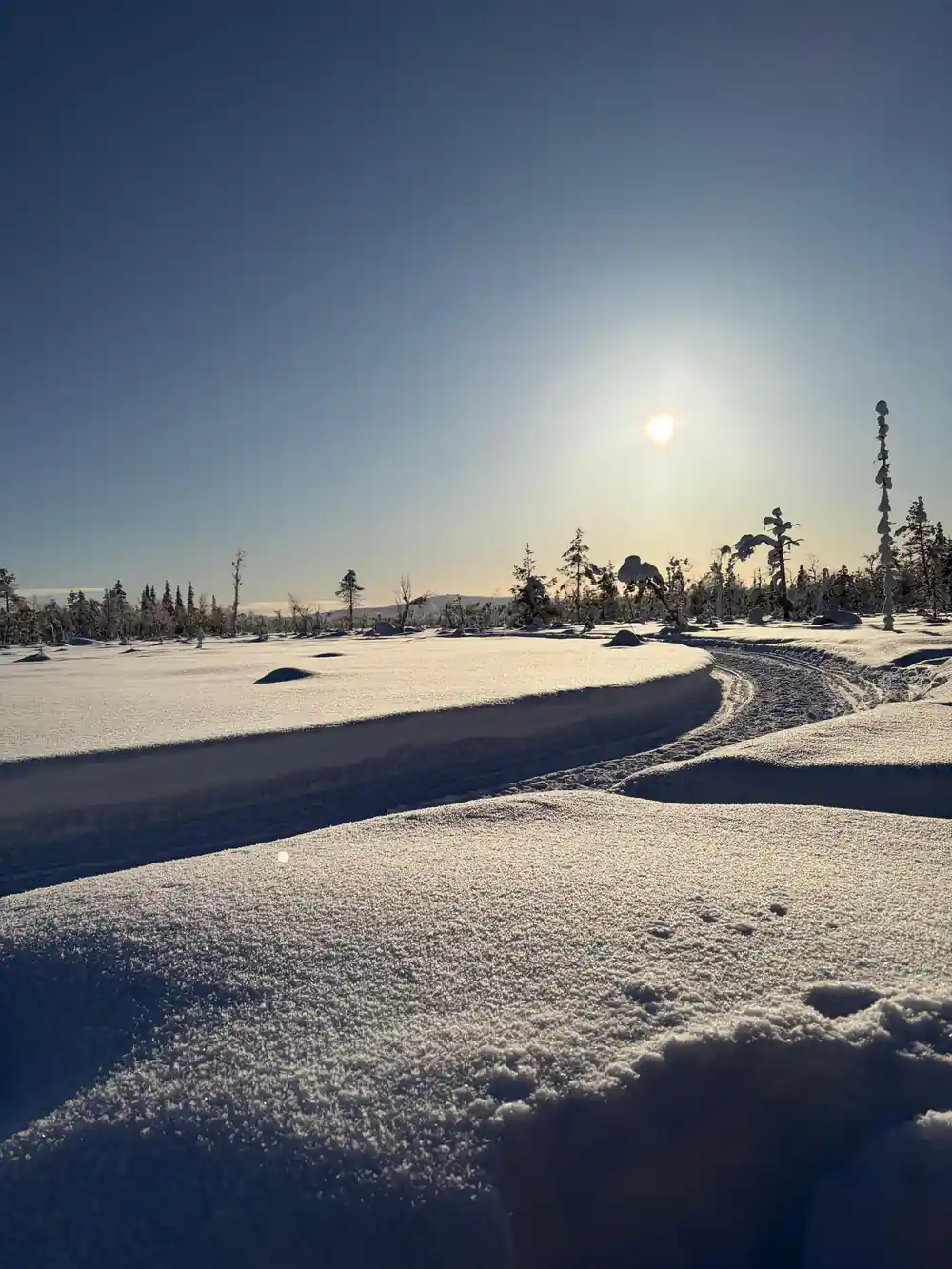
What happens instead is that the sky brightens through the late morning into a long blue twilight, holds there around the middle of the day, and fades again through the afternoon. The colour is the point. Snow under a sky lit by a sun just below the horizon goes a deep saturated blue that has no equivalent further south, and it lasts for hours rather than the few minutes of blue hour you would get in London or Berlin.
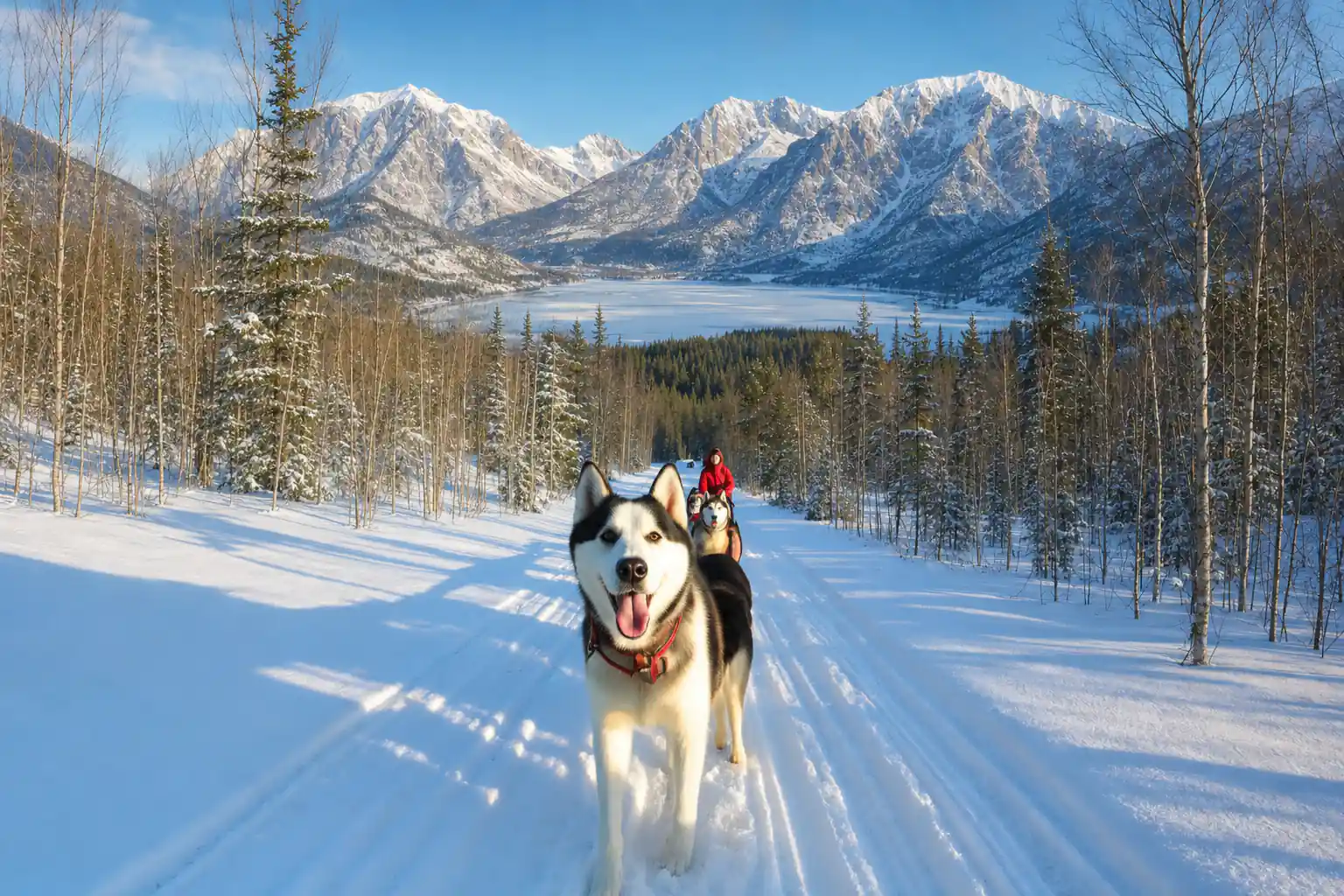
For a husky tour this means a midwinter run is not a run in the dark. It is a run in blue light, which is a good deal more interesting to look at and a good deal harder to photograph.
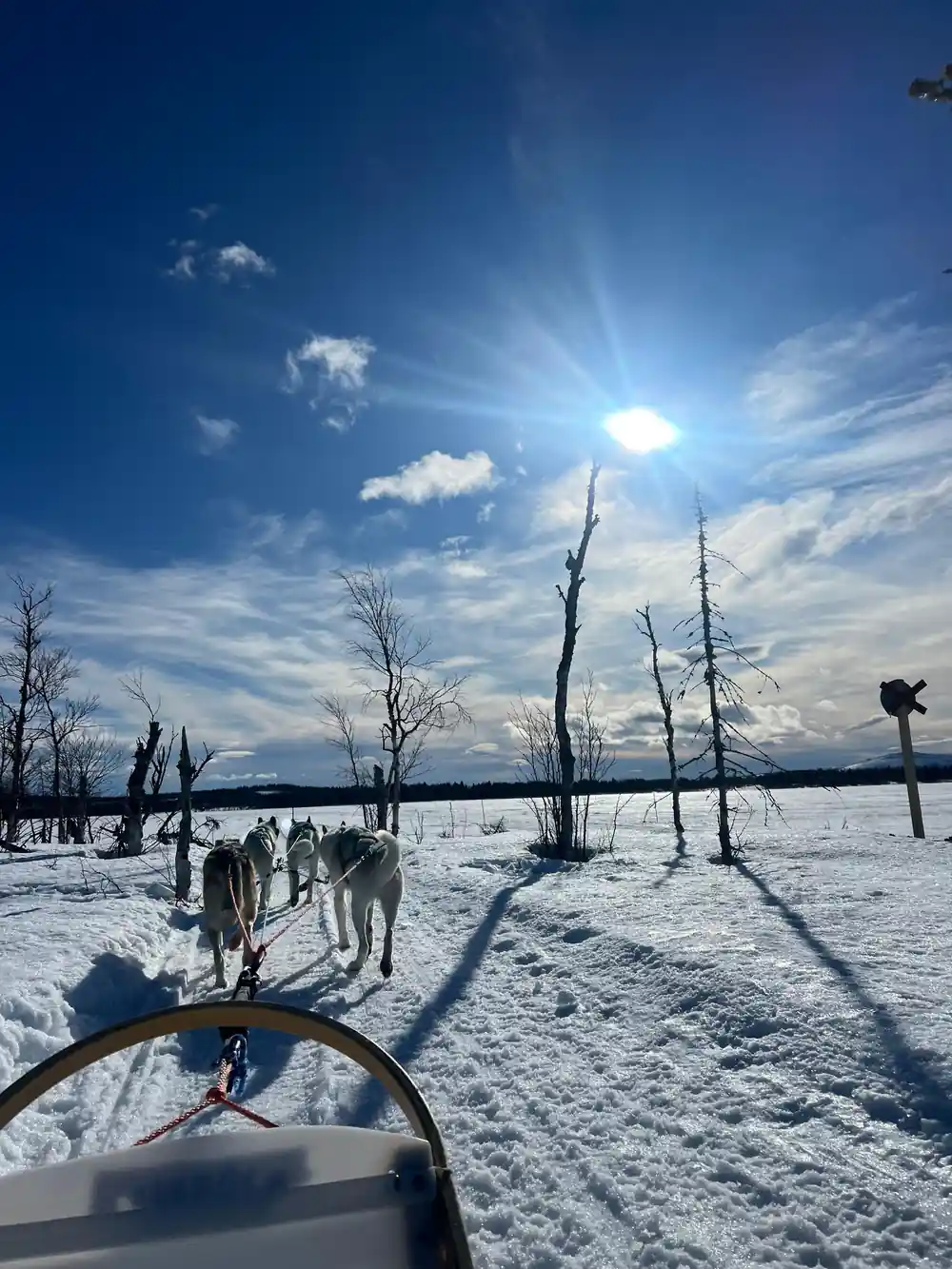
Blue twilight on snow, which is what midwinter here actually looks like
Month by month through the season
November gives about four hours in the middle of the month and is falling fast. December bottoms out at zero. January recovers to two and a half hours and then climbs steeply. February is at seven, March at eleven, and April at fifteen, by which point the light is no longer a constraint on anything.
The practical consequence is that a December or early January booking will run in twilight and an afternoon booking in March will run in full daylight. Neither is better; they are different trips. The twilight one is more atmospheric and the daylight one shows you more of the landscape.
It also means the tour start time matters more in midwinter than at any other time of year. In December an hour either way changes what you see considerably.
When the aurora is possible, and when it is not
The northern lights are not a winter phenomenon. They are a darkness phenomenon. The activity that causes them runs all year; it is only visible when the sky is dark enough, which at this latitude means from late August to early April.
That has two consequences worth stating plainly. The first is that the aurora is impossible in June and July here, no matter how strong the activity, because it never gets dark. The second is that late August and September are genuinely good months for it, which surprises people who associate it with deep winter.
Within the season, what you need is a clear sky and patience. Cloud is the enemy rather than cold, and Kittila in midwinter is often clear precisely because the coldest air is the driest.
24 h
Mid-June at Levi: the sun does not set. Six months later, on 15 December, it does not rise. The same latitude produces both.
Seeing the lights from the trail
It happens, and it is not what the tour is for. A two-hour daytime husky booking is not an aurora hunt and should not be booked as one. If the run falls late in the day in midwinter and the sky is clear and the activity is up, you may see something, and the guides will be the first to notice.
What the location does have in its favour is darkness away from the village. Ten minutes out of Levi there is very little light pollution, and the trail at Rautusjarvi runs partly across an open frozen lake, which is exactly the kind of unobstructed northern horizon an aurora watcher wants.
If seeing the lights is the priority, book a dedicated evening tour and treat any sighting on the sled as a bonus.
Photographing light this far north
Two problems, both solvable. The first is that twilight is much darker than it looks to the eye, because human vision compensates in a way a camera does not. Automatic settings in blue hour produce grey, noisy, disappointing images.
The second is cold. Battery capacity falls sharply below minus ten, and a phone that shows eighty per cent indoors can shut down within twenty minutes outside. Keep a spare inside a jacket against your body, and put the cold one there to recover rather than assuming it is dead.
The third, which is not a problem but a habit worth having, is to stop trying at some point. The best five minutes of a midwinter sled run are usually the ones nobody photographed.
Midsummer, and the other extreme
It is worth knowing what the same place does in the other direction, because a surprising number of visitors come back. From late May to late July the sun does not set at Levi, and mid-June is a full twenty-four hours of daylight.
There is no husky sledding then, for obvious reasons. Kennels switch to cart training and rest, dogs shed their winter coats, and the fell that carried metres of snow in March is walking country by July.
The point is that the darkness that makes a December tour atmospheric and the light that makes a June visit strange are the same fact seen from two ends of the year.
A midwinter run happens in blue light rather than daylight
from US$173Reserve now & pay later